

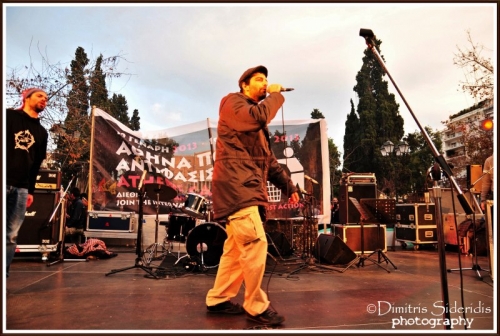
On Saturday, ROAR contributor Leonidas performed with activist hip-hop formation Social Waste at the anti-fascist concert on Syntagma Square, Athens.
Leo is too humble to share this kind of stuff himself, but here goes: our very own ROAR contributor Leonidas Oikonomakis — member of the legendary Greek hip hop formation Social Waste — speaking truth to power on Syntagma Square during last weekend’s anti-fascist concert. More than 10,000 people in attendance (‘Meh, I had expected more’, our favorite Cretan rhinoceros grumbled afterwards). Below the video is a translation of his excellent lyrics, partly inspired by the documentary Leo co-directed in Greece last year:
At Utopia’s Fiesta
By Leonidas Oikonomakis
It must have been on some Sunday, or some Monday
In a poem of Lorca, in the paintings of Rivera
In the Sea of Hikmet, the words of Galeano
And before getting to you, I always lose you
It must have been on a workday, or a holiday
Placards, banners, “state closed’, and strike
In some lyric of Akis Panou, or of Rasoulis that is shouting
“it can change Kemal, it can change”
The more I approach her, the more she goes further and I never reach her
Unapproachable, beautiful Utopia — Galeano was right
But when she is celebrating, she is promising me new paths
And then I start to believe again that the world can change
And I doubt Kemal, I also doubt Manos
I stand on my toes, but still I cannot reach her
The game is an old one, and if you want us to find the meaning
We gotta raise ourselves a bit higher
The poets have warned us, the game’s rules
Were written by the centuries with ink of red
Just like back then in Chile, it must have been 11 de Setiembre
And you said “let it be” and “hasta la Victoria siempre”
Or like now that they told me they saw you in India
Harvesting sun and wind, together with the barefoot
With a red beret they also saw you once,
You were a word in the mouth of Thomas Sankara
And even now they still see you and ask the people
Where are the Don Quijotes and the Sanchos going?
You become a witch-moon, at night you set our path
And during the day, you just let us travel for fun
It must have been on some Sunday, some Monday
In a poem of Lorca, in the paintings of Rivera
In the Sea of Hikmet, the words of Galeano
And before getting to you, I always lose you
It must have been on a workday, or a holiday
Placards, banners, “state closed’, and strike
In some lyric of Akis Panou, or of Rasoulis that is shouting
“it can change Kemal, it can change”
I‘ve looked for you lots, I followed the footsteps
They brought me to Chiapas — guerillas in the mist
At Syntagma, at the Square, thousands touched you
And earlier, in Iberia, Puerta del Sol and Catalunya
In Egypt and Tunisia you were flame and light
In Mexico they named you #YoSoy132
Salome is throwing her veils, head on the dish
But the precariato is resisting
Workers in the Greek Steelworks, “(we are) on strike cabrones!”
And miners in Asturias “…hasta los cojones”
Students in Santiago and Montreal
Because education is a public and free good
In Argentina barricades just like in the old times
In Cochabamba “the water is not for sale assholes!”
I’ve been expecting you to come like a May of ‘68
Or like a prohibited song of Oscar Chavez
You were a jailed book in Turkey
And a dead reporter in Homs, Syria
In some places they call you Zapata, elsewhere Tupac Katari
Elsewhere Sandino, and in Greece, Ari
It must have been on some Sunday, some Monday
In a poem of Lorca, in the paintings of Rivera
In the Sea of Hikmet, the words of Galeano
And before getting to you, I always lose you
It must have been on a workday, or a holiday
Placards, banners, “state closed’, and strike
In some lyric of Akis Panou, or of Rasoulis that is shouting
“it can change Kemal, it can change”
* The phrase “it can change Kemal” is a reference to a lyric of Nikos Gatsos, in a song with Manos Hatzidakis entitled “Kemal”, which ends with the phrase “Goodnight Kemal, this world will never change”
**Manolis Rasoulis and Akis Panou were Greek songwriters.

{ 4 comments… read them below or add one }
Excellent lyrics… keep on fighting Leo!
Hear now the story of Kemal
A young prince from the East
A descendant of Sinbad the Sailor,
Who thought he could change the world.
But bitter is the will of Allah,
And dark the souls of men …
>>
Once upon a time in the East,
The coffers are empty, the waters are stagnant.
In Mosul, in Basrah, under an old date-palm,
The children of the desert are bitterly crying.
A young man of ancient and royal race
Overhears their lament and goes to them.
The Bedouins look at him sadly
And he swears by Allah that things will change.
>>
When they learn of the young man’s fearlessness,
The rulers set off with wolf-like teeth and a lion’s mane.
From the Tigris to the Euphrates, in heaven and on earth,
They pursue the renegade to catch him alive.
They pounce on him like uncontrollable hounds,
And take him to the caliph to put the noose around his neck.
Black honey, black milk he drank that morning
Before breathing his last on the gallows.
>>
With two aged camels and a red steed,
At the gates of heaven the prophet awaits.
They walk together among the clouds
With the star of Damascus to keep them company.
After a month, after a year, they find Allah
Who, from his high throne, tells foolish Sinbad:
‘O my vanquished upstart, things never change;
Fire and sword are the only things men know.’*
Goodnight, Kemal. The world will never change. Goodnight…
Thanks for this lyric. I’m mexican and here, in my country, there are a lot of people; students, teachers, farmers, women, homosexuals, indigenous and so on, that fight every day against the system. And of course for all us, zapatista people is an enormous example of dignity and resistence!!
Greetings .
Beautiful poem Leo. It put me in mind of ‘The Rhythm of Time’ by Bobby Sands
There’s an inner thing in every man,
Do you know this thing my friend?
It has withstood the blows of a million years,
And will do so to the end.
It was born when time did not exist,
And it grew up out of life,
It cut down evil’s strangling vines,
Like a slashing searing knife.
It lit fires when fires were not,
And burnt the mind of man,
Tempering leadened hearts to steel,
From the time that time began.
It wept by the waters of Babylon,
And when all men were a loss,
It screeched in writhing agony,
And it hung bleeding from the Cross.
It died in Rome by lion and sword,
And in defiant cruel array,
When the deathly word was ‘Spartacus’
Along the Appian Way.
It marched with Wat the Tyler’s poor,
And frightened lord and king,
And it was emblazoned in their deathly stare,
As e’er a living thing.
It smiled in holy innocence,
Before conquistadors of old,
So meek and tame and unaware,
Of the deathly power of gold.
It burst forth through pitiful Paris streets,
And stormed the old Bastille,
And marched upon the serpent’s head,
And crushed it ‘neath its heel.
It died in blood on Buffalo Plains,
And starved by moons of rain,
Its heart was buried in Wounded Knee,
But it will come to rise again.
It screamed aloud by Kerry lakes,
As it was knelt upon the ground,
And it died in great defiance,
As they coldly shot it down.
It is found in every light of hope,
It knows no bounds nor space
It has risen in red and black and white,
It is there in every race.
It lies in the hearts of heroes dead,
It screams in tyrants’ eyes,
It has reached the peak of mountains high,
It comes searing ‘cross the skies.
It lights the dark of this prison cell,
It thunders forth its might,
It is ‘the undauntable thought’, my friend,
That thought that says ‘I’m right!’
Keep writing Leo