

The two banksters who helped lead Europe to ruin
- June 12, 2011
Capitalism & Crisis
For over a year, Deutsche Bank and the ECB made us believe that a Greek default would be disastrous for Europe. They were lying through their teeth.
- Author
In Frankfurt, two of Europe’s most powerful men sit virtually across the street from one another in the high-rise headquarters of two of the continent’s most important institutions. No one elected these men to rule over us. Star step daughter No one voted for their institutions to dictate our economic policy. Yet they do.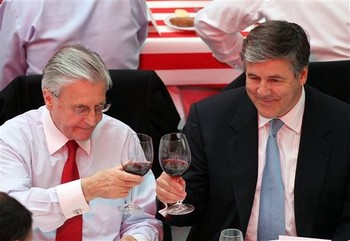 Meet Jean-Claude Trichet and Josef Ackermann. The former is the departing head of the European Central Bank and was recently ranked one of the five most powerful people in the world by Newsweek. The latter is the head of the largest private bank in the eurozone, Deutsche Bank, and was just named the “most powerful banker in Europe” by the New York Times. Neither was elected to run the economy. Yet, together, they do.
In fact, both men have been instrumental in shaping the EU policy response to the crippling debt crisis that continues to haunt the eurozone. As the Times reported in a powerful feature today, Mr. Ackermann “is at the center of more concentric circles of power than any other banker on the continent.” Indeed:
He regularly advises politicians and policy makers on the most pressing economic issues of the day: the smoldering debt crises in Greece; the widening gulf between the economically strong nations of Europe, like Germany, and weaker ones like Ireland and Portugal; and the future of Europe’s economic and monetary union and that grand venture’s most manifest expression, the euro.
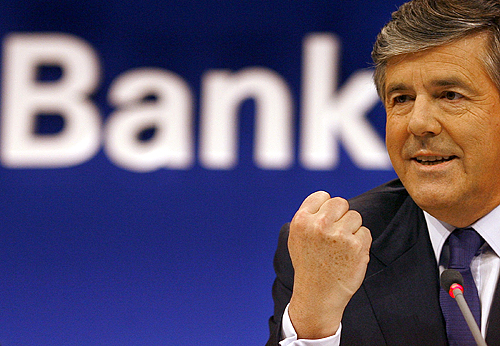 At the same time, the NYT notes, Ackermann is “possibly the most dangerous” banker in Europe too. After all, “it is no secret where Mr. Ackermann’s financial allegiances lie: with the banks.” For example, Ackermann “has insisted that providing some sort of debt relief for Greece would be a huge mistake.”
What would be the problem with such a partial Greek default? As Argentina and Ecuador amply demonstrated in the last decade, a sovereign debt restructuring can actually set a country free from the growth-inhibiting austerity measures imposed by foreign lenders, allowing it to recover much faster while catering to domestic needs and concerns.
 But of course, we have to remember that Ackermann is not a neutral observer. There is an agenda behind his apocalyptic narrative. As the Times correctly observed, “European banks, including German ones like Deutsche Bank, hold many billions of euros in Greek government bonds, and the banks would lose big if those debts were restructured.”
Yet because Ackermann managed to convince Merkel, Trichet and other EU leaders that a Greek default would unleash another Lehman’s moment, “Europe’s solution for Greece is, essentially, Mr. Ackermann’s: more bailout money and more austerity — an approach that some economists say only buys time without offering any hope of recovery.”
Thus, blinded by his own greed and unwillingness to take responsibility for the irresponsible loans his bank made in the build-up to the crisis, Ackermann is only making the crisis worse — thereby increasing the likelihood of the disastrous consequences he warns about so manically. Yet Europe is paralyzed. Our leaders have bought the lie. Why is this?
A major reason for Ackermann’s success is that he has had the backing of his neighbors at the ECB throughout the crisis. Ever since Greece sank into the abyss of global capital markets early last year, Jean-Claude Trichet has narrowly toadied to the interests of the large European banks, calling a restructuring simply “too risky.”
Not coincidentally, “Mr. Ackermann … seems to enjoy a good relationship with Jean-Claude Trichet.” When Merkel suggested that private lenders might have to take a share of the burden, Ackermann “opposed the German government and sided with his friend Mr. Trichet … in arguing against restructuring the Greek debt, which would force investors — and banks — to share Greece’s pain.”
 Today, the vast majority of economic experts — both on the Left and on the Right — have come to the conclusion that Greece is insolvent. It just cannot realistically repay its overwhelming debt while the economy keeps contracting as a result of the brutish austerity measures that Ackermann and Trichet have been prescribing.
Even the German government and eurozone president Jean-Claude Juncker are now calling for a so-called “soft restructuring” of the Greek debt. But the ECB refuses to budge. While such a stern attitude could be expected from a self-interested giant like Deutsche Bank, it is rather surprising to see it from a supposedly ‘neutral’ agent like the ECB.
So why does the ECB continue to oppose the one and only real solution to the Greek debt crisis? Why does it continue to push Greece, and with it the entire eurozone, towards the abyss? Is it just because Trichet is such close buddies with Ackermann and co.? Or is there something else going on here?
 Obviously, there is. Trichet made a major mistake last year, when he decided to side with his friend Ackermann in opposing an early debt restructuring. Rather than retaining his objective neutrality as the head of the ECB, Trichet got directly involved in the Greek debt crisis: he started buying up vast amounts of Greek bonds on secondary markets, just to keep Greece afloat and thereby prevent European banks and investors from having to take a haircut.
As a result, it is no longer just Europe’s private banks, but also its Central Bank, that now finds itself stuck neck-deep in this Greek debt. A Greek default, in other words, would no longer just harm private banks — it would force Trichet to take major losses on the ECB balance sheet just months before he is set to pass over the reigns to Mario Draghi.
It is time for European leaders to wake up to the painful reality we have been suppressing all along. Europe is not facing a sovereign debt crisis, as Ackermann and Trichet have made us believe. In reality, Europe is facing a financial crisis in its own banking sector. Not just Greece, Portugal and Ireland, but the vast majority of Europe’s largest banks is insolvent.
Even worse, the failure of European leaders to tackle the Greek debt crisis appropriately by allowing a managed default last year has compounded the problems. The ECB is now at risk of becoming the highest profile ‘victim‘ of the global financial crisis yet. With a peripheral exposure of up to €440bn, asset losses as small as 4.25% could tip the ECB into insolvency.
According to a report by Open Europe:
Hefty losses for the ECB are no longer a remote risk … Despite further bailouts from the EU and the IMF, Greece is likely to default within the next few years, which would also bring down the country’s banks. The resulting losses to the ECB are estimated to be between €44.5bn and €65.8bn. “This is equal to between 2.35% and 3.47% of assets, meaning it comes close to wiping out the (ECB’s) capital base.”
The only way to hide this terrible reality from the population at large, has been to keep bailing out the periphery and impose draconian austerity measures, thereby creating a closed loop from the Northern European tax payer through the Greek government to the balance sheets of Europe’s troubled banks.
Throughout the crisis, the much-touted myths about Greek laziness and Mediterranean values merely served as a ploy to distract German taxpayers from the incontrovertible truth that they were bailing out their own ailing banks. The ire of the Northern populists has been directed at struggling workers in the South, while the banksters were the real profiteers.
In fact, we never really bailed out Greece, Portugal or Ireland. We bailed out Ackermann and his friends. And soon, we’ll be forced to bail out Trichet as well. In the greatest irony of all, the initial lie that a Greek default would have disastrous consequences for Europe, was repeated so often that it was turned into a reality. If we had acted a year-and-a-half ago to allow a Greek debt restructuring, the financial fallout could have been limited.
But now that the ECB is severely exposed, Ackermann’s scaremongering has become a self-fulfilling prophecy. So let this single truth be told to all: we are still living under the dictatorship of financial capital, where two bankers have the power to shape reality for all of us. And until we confront those banksters and rise up to break out of their invisible chains, we will steadily be led to ruin.
Source URL — https://roarmag.org/essays/deutsche-bank-ecb-greek-debt-crisis/
 Digital subscriber
  Print & Digital subscriber